
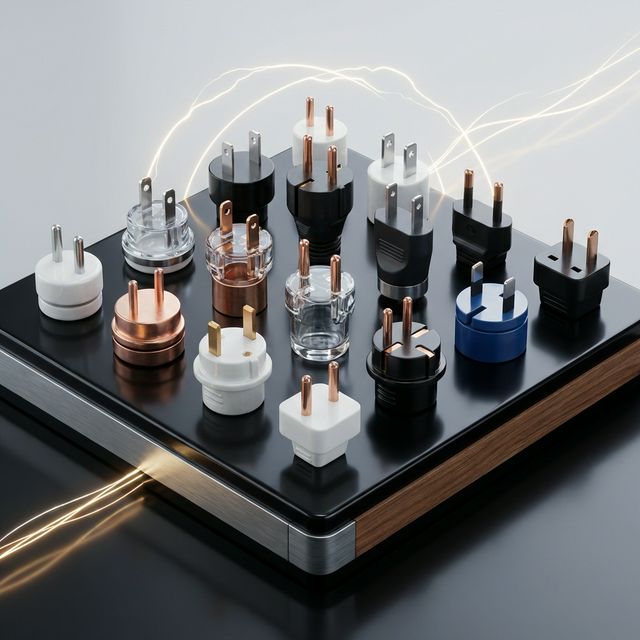
World Voltage and Plug Type Guide: Why Is It Different Everywhere?
When preparing for an international trip, one of the first things we pack is a 'travel adapter.' But as you pack, you might wonder: "Why does Japan use 110V while Korea uses 220V?" or "Why are British plugs so bulky and complex?"
This guide doesn't just list voltage numbers; it explores the fascinating historical backgrounds and provides practical, step-by-step advice on how to keep your valuable electronics safe while traveling. We'll help you decode the jargon so you can focus on your journey, not on blown fuses.
1. 110V vs. 220V: The History of the 'Current Wars'
Today, the world is divided into two main camps: the 110V-120V (60Hz) system used in North America and Japan, and the 220V-240V (50Hz) system used in Europe and most of Asia. This split is a legacy of the late 19th-century 'Battle of the Currents.'
💡 Edison's Safety vs. Tesla's Efficiency
- Thomas Edison (Pro-110V): Developing early incandescent bulbs, Edison championed 110V Direct Current (DC). He even used fear-mongering tactics against high voltage to push his low-voltage standard. As a result, the U.S. and countries under its influence maintained the 110V-120V range.
- Nikola Tesla (Pro-High Voltage AC): Tesla argued for high-voltage Alternating Current (AC), which is far more efficient for long-distance transmission. High voltage significantly reduces power loss over wires. Consequently, European nations adopted 220V-230V as their standard for its superior efficiency.
🇰🇷 Korea's '220V Miracle'
Interestingly, South Korea used to be a 110V country. From 1973 to 2005, the nation underwent a massive 32-year project to upgrade its entire grid to 220V. This is considered one of the most successful infrastructure overhauls in history, reducing power loss by 75% and providing the stable energy foundation needed for Korea's rise as a global electronics powerhouse.
2. World Plug Types (Type A to N) Explained
The International Electrotechnical Commission (IEC) classifies plug shapes from A to N. These differences exist because early electrical and communication standards were set independently by different nations.
| Type | Common Countries | Key Features |
|---|---|---|
| Type A / B | USA, Japan, Canada, Taiwan | Two flat parallel pins (B adds a grounding pin) |
| Type C / F | Korea, Germany, France, Russia | Two round pins (F includes side grounding clips) |
| Type G | UK, Hong Kong, Singapore | Three large flat pins (Includes built-in safety shutters) |
| Type I | Australia, New Zealand, China | Two flat pins in a 'V' shape |
3. Checking 'Free Voltage': Protecting Your Devices
A travel adapter only changes the Interface (shape) of the plug; it does not convert the Voltage. Plugging a 220V-only device into a 110V outlet in Japan might result in poor performance or damage, while the reverse (110V device in a 220V outlet) can cause a literal explosion.
🔍 Look for 'INPUT' on Your Charger
Check the fine print on your device's power brick or battery compartment:
- INPUT: 100-240V, 50/60Hz: Congratulations! This is a 'Free Voltage' device. It will work anywhere in the world with just a shape adapter. (e.g., Smartphones, Laptops, Tablets)
- INPUT: 220V Only: This device MUST only be used in 220V environments. Using it in a 110V country can fry the internal circuitry.
⚠️ High-Risk Appliances to Watch
Appliances that generate heat—such as hair dryers, electric kettles, curling irons, and electric blankets—consume massive amounts of power. These are often 'Single Voltage.' Instead of lugging around a heavy and dangerous transformer, it’s safer to buy a dedicated travel version or use local appliances.
4. Practical Guide: Global Electricity Summary Table
| Country/Region | Voltage (V) | Frequency (Hz) | Recommended Adapter | Tip |
|---|---|---|---|---|
| Japan | 100 V | 50 / 60 Hz | Type A | East/West Japan use different frequencies |
| USA / Canada | 120 V | 60 Hz | Type A / B | 110V devices are generally compatible |
| Vietnam | 220 V | 50 Hz | Type A / C | Many hotels support Korean/European plugs |
| Germany / EU | 230 V | 50 Hz | Type C / E / F | Standard European round pins |
| Thailand | 220 V | 50 Hz | Mixed | Bringing a universal adapter is highly recommended |
5. Pro Tips for Safe International Charging
- Ask the Front Desk: Most 4-5 star hotels now have 'Universal Outlets' that accept multiple plug types without an adapter. Always check before unpacking your kit.
- The Power Strip Trick: You only need one travel adapter if you bring a small power strip from home. Plug the strip into the adapter, and you can charge your phone, laptop, and camera simultaneously with your home plugs.
- Check for USB Ports: Modern aircraft seats and airport lounges often have USB-A or USB-C ports, allowing you to charge your mobile devices with just a cable.
For a safe and stress-free trip, it is vital to check if your electronics are 'Free Voltage' before you leave. Furthermore, if you are moving or staying long-term in a country with a different voltage, it is often better for the lifespan of your devices and your overall safety to buy new, local appliances rather than relying on a voltage converter.