
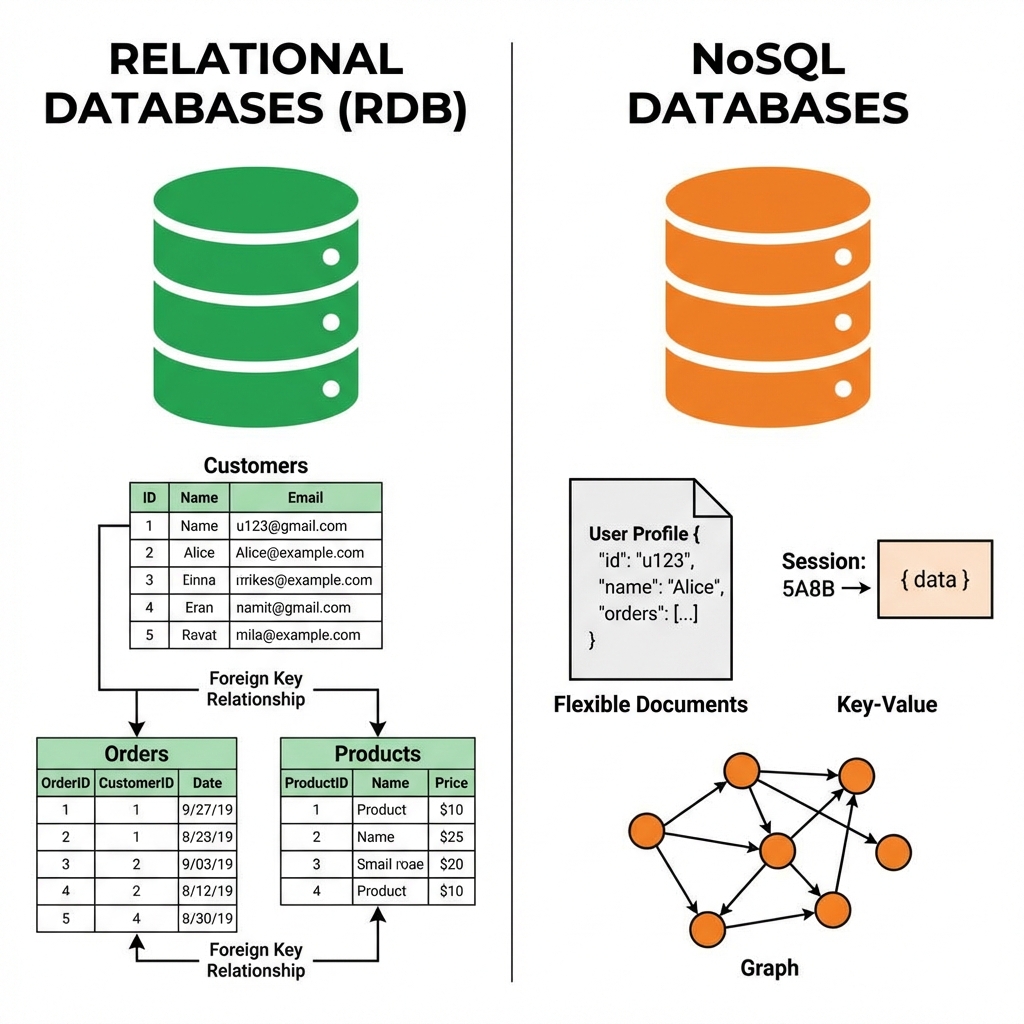
RDB vs NoSQL: Choosing the Right Database
Databases are the foundation of modern software. There is no one-size-fits-all answer to choosing between RDB and NoSQL. The best approach is to carefully evaluate your project's data structure and scalability needs.
What is a Relational Database (RDB)?
RDB stores data in table format and uses SQL (Structured Query Language) to manage data.
Key Features of RDB
1. Schema
CREATE TABLE users (
  id INT PRIMARY KEY,
  name VARCHAR(100) NOT NULL,
  email VARCHAR(100) UNIQUE,
  created_at TIMESTAMP DEFAULT CURRENT_TIMESTAMP
);
2. Relationships
CREATE TABLE orders (
  id INT PRIMARY KEY,
  user_id INT,
  FOREIGN KEY (user_id) REFERENCES users(id)
);
3. ACID Properties
- Atomicity: Transaction succeeds completely or fails completely
- Consistency: Data integrity maintained
- Isolation: No interference between concurrent transactions
- Durability: Committed data permanently saved
RDB Advantages
- Data integrity: Foreign keys and constraints prevent bad data
- Complex queries: JOIN, subqueries for various analyses
- Transaction support: Essential for financial operations
- Mature ecosystem: Decades of proven technology
RDB Disadvantages
- Difficult horizontal scaling: Limited performance improvement by adding servers
- Schema change cost: Entire data migration needed for structure changes
- Large data limits: Performance degradation with billions of records
What is NoSQL?
NoSQL stands for "Not Only SQL", storing data in various non-relational ways.
NoSQL Types
1. Document Store - MongoDB, CouchDB
{
  "_id": "user123",
  "name": "John Doe",
  "email": "john@example.com",
  "addresses": [
    { "type": "home", "city": "Seoul" },
    { "type": "office", "city": "Busan" }
  ]
}
2. Key-Value Store - Redis, DynamoDB
SET user:123:name "John Doe"
GET user:123:name // "John Doe"
3. Column-Family Store - Cassandra, HBase
- Optimized for large-scale data analysis
- Great for time-series data, log data
4. Graph Database - Neo4j, ArangoDB
- Perfect for social networks, recommendation systems
- Very fast relationship traversal
NoSQL Advantages
- Flexible schema: Easy to add/remove fields
- Easy horizontal scaling: Linear performance improvement with added servers
- Fast read/write: High throughput with simple structure
- Large data handling: Efficient processing of billions of records
NoSQL Disadvantages
- Limited complex queries: JOIN difficult or impossible
- Weaker consistency: Eventual Consistency
- Limited transaction support: Some NoSQL don't support ACID
- Learning curve: Different query language for each NoSQL
When to Choose Each
Choose RDB When:
1. Financial/Payment Systems
BEGIN TRANSACTION;
UPDATE accounts SET balance = balance - 100 WHERE id = 1;
UPDATE accounts SET balance = balance + 100 WHERE id = 2;
COMMIT;
2. Complex Relationships
- ERP, CRM systems
- E-commerce (order-product-customer relationships)
- Reservation systems
3. Heavy Reporting/Analytics
Choose NoSQL When:
1. Real-time Big Data
- Log collection and analysis
- IoT sensor data
- Social media feeds
2. Rapid Prototyping
db.products.insertOne({
  name: "New Product",
  price: 10000,
  discount: 0.1,
  tags: ["new", "sale"]
});
3. Caching Layer
await redis.set(`session:${userId}`, JSON.stringify(sessionData), 'EX', 3600);
4. Content Management Systems (CMS)
Hybrid Approach
Modern applications often use both together:
┌─────────────────────────────────┐
│   Application Architecture      │
├─────────────────────────────────┤
│ PostgreSQL (RDB)                │
│ - User information              │
│ - Order data                    │
│ - Payment info                  │
├─────────────────────────────────┤
│ MongoDB (NoSQL)                 │
│ - Product catalog               │
│ - User activity logs            │
├─────────────────────────────────┤
│ Redis (NoSQL)                   │
│ - Session cache                 │
│ - Real-time rankings            │
└─────────────────────────────────┘
| Comparison | RDB | NoSQL |
|---|---|---|
| Schema | Fixed | Flexible |
| Scalability | Vertical (Scale-up) | Horizontal (Scale-out) |
| Transactions | Strong ACID | Limited or None |
| Queries | Complex JOIN possible | Simple lookup optimized |
| Use Cases | Finance, ERP, CRM | Big Data, Real-time, SNS |
There's no single answer. Choose based on project requirements, data characteristics, and team experience. Often, a hybrid approach using both is the best solution.