
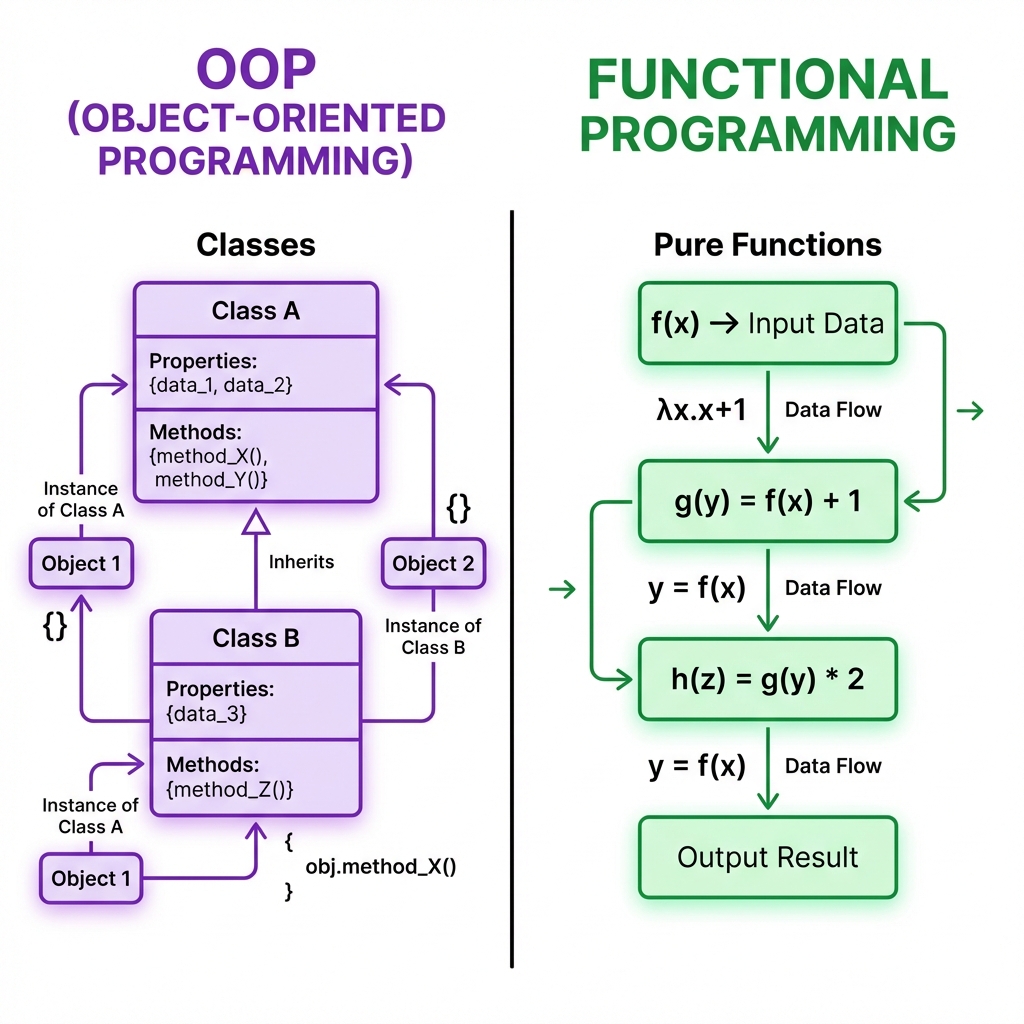
OOP vs Functional Programming
Programming paradigms are approaches to how we structure and think about code. Object-Oriented and Functional are the two most widely used paradigms.
Object-Oriented Programming (OOP)
Core Concept
OOP bundles data and methods that process that data into objects.
// Object-Oriented approach
class BankAccount {
  constructor(owner, balance) {
    this.owner = owner;
    this.balance = balance;
  }

  deposit(amount) {
    this.balance += amount;
    return this.balance;
  }

  withdraw(amount) {
    if (this.balance >= amount) {
      this.balance -= amount;
      return this.balance;
    }
    throw new Error("Insufficient funds");
  }
}

const account = new BankAccount("John", 10000);
account.deposit(5000);  // 15000
account.withdraw(3000); // 12000
Four Pillars of OOP
1. Encapsulation
class User {
  #password;  // private field

  constructor(username, password) {
    this.username = username;
    this.#password = this.#hashPassword(password);
  }

  #hashPassword(password) {
    return btoa(password);
  }

  verifyPassword(inputPassword) {
    return this.#hashPassword(inputPassword) === this.#password;
  }
}
2. Inheritance
class Animal {
  constructor(name) {
    this.name = name;
  }

  speak() {
    console.log(`${this.name} makes a sound.`);
  }
}

class Dog extends Animal {
  speak() {
    console.log(`${this.name} barks.`);
  }
}
3. Polymorphism
class Shape {
  area() {
    throw new Error("Implementation required");
  }
}

class Circle extends Shape {
  constructor(radius) {
    super();
    this.radius = radius;
  }

  area() {
    return Math.PI * this.radius ** 2;
  }
}

class Rectangle extends Shape {
  constructor(width, height) {
    super();
    this.width = width;
    this.height = height;
  }

  area() {
    return this.width * this.height;
  }
}
4. Abstraction
class CoffeeMachine {
  #water = 0;
  #beans = 0;

  addWater(amount) {
    this.#water += amount;
  }

  addBeans(amount) {
    this.#beans += amount;
  }

  makeCoffee() {
    if (this.#water < 100 || this.#beans < 10) {
      throw new Error("Insufficient ingredients");
    }
    this.#water -= 100;
    this.#beans -= 10;
    return "☕ Coffee ready!";
  }
}
Functional Programming (FP)
Core Concept
FP centers on pure functions and immutability.
// Functional approach
const createAccount = (owner, balance) => ({
  owner,
  balance
});

const deposit = (account, amount) => ({
  ...account,
  balance: account.balance + amount
});

const withdraw = (account, amount) => {
  if (account.balance >= amount) {
    return {
      ...account,
      balance: account.balance - amount
    };
  }
  throw new Error("Insufficient funds");
};

// Usage (original data unchanged)
const account1 = createAccount("John", 10000);
const account2 = deposit(account1, 5000);
const account3 = withdraw(account2, 3000);

console.log(account1.balance);  // 10000 (original preserved)
console.log(account3.balance);  // 12000
Core Principles of FP
1. Pure Functions
// Pure function (Good)
const add = (a, b) => a + b;
add(2, 3);  // Always 5

// Impure function (Bad)
let total = 0;
const addToTotal = (value) => {
  total += value;  // Modifies external state
  return total;
};
2. Immutability
// Bad: Mutating original
const numbers = [1, 2, 3];
numbers.push(4);  // Mutates original

// Good: Creating new array
const numbers2 = [1, 2, 3];
const newNumbers = [...numbers2, 4];  // New array
3. Higher-Order Functions
const numbers = [1, 2, 3, 4, 5];

const doubled = numbers.map(n => n * 2);
const evens = numbers.filter(n => n % 2 === 0);
const sum = numbers.reduce((acc, n) => acc + n, 0);
4. Function Composition
const compose = (...fns) => (x) =>
  fns.reduceRight((acc, fn) => fn(acc), x);

const addOne = (x) => x + 1;
const double = (x) => x * 2;
const square = (x) => x ** 2;

const calculate = compose(square, double, addOne);
console.log(calculate(3));  // ((3 + 1) * 2) ** 2 = 64
Comparison: Shopping Cart Implementation
Object-Oriented Approach
class ShoppingCart {
  constructor() {
    this.items = [];
  }

  addItem(product, quantity) {
    const existingItem = this.items.find(item => item.product.id === product.id);

    if (existingItem) {
      existingItem.quantity += quantity;
    } else {
      this.items.push({ product, quantity });
    }
  }

  getTotal() {
    return this.items.reduce((sum, item) =>
      sum + (item.product.price * item.quantity), 0
    );
  }
}
Functional Approach
const createCart = () => [];

const addItem = (cart, product, quantity) => {
  const existingItem = cart.find(item => item.product.id === product.id);

  if (existingItem) {
    return cart.map(item =>
      item.product.id === product.id
        ? { ...item, quantity: item.quantity + quantity }
        : item
    );
  }

  return [...cart, { product, quantity }];
};

const getTotal = (cart) =>
  cart.reduce((sum, item) => sum + (item.product.price * item.quantity), 0);
Pros and Cons
OOP Advantages
- Intuitive: Easy to model real world
- Encapsulation: Data protection and hiding
- Reusability: Code reuse through inheritance
- Large systems: Good for structuring complex systems
OOP Disadvantages
- State management: Bugs from object state changes
- Testing difficulty: Complex with many dependencies
- Parallel processing: Concurrency issues with shared state
FP Advantages
- Predictable: Pure functions always return same result
- Easy testing: Simple testing without side effects
- Parallel processing: No concurrency issues with immutability
- Debugging: Easy to track state changes
FP Disadvantages
- Learning curve: Difficult concepts
- Performance: Memory usage from maintaining immutability
- Real-world modeling: Some domains more natural with OOP
When to Use Each
Choose OOP for:
- Game development: Character, item-centric objects
- GUI applications: Buttons, windows components
- Simulations: Real-world modeling
- Large enterprise: Complex business logic
Choose FP for:
- Data transformation: Pipeline processing
- Async processing: Promise, async/await
- State management: Redux, Zustand
- Mathematical calculations: Algorithms, data analysis
Hybrid Approach
Modern JavaScript mixes both paradigms.
// React: OOP + FP hybrid
class UserProfile extends React.Component {  // OOP: class
  render() {
    const { user } = this.props;

    // FP: pure function, immutability
    const fullName = [user.firstName, user.lastName]
      .filter(Boolean)
      .join(' ');

    return <div>{fullName}</div>;
  }
}

// Or functional component (more preferred)
const UserProfile = ({ user }) => {
  const fullName = [user.firstName, user.lastName]
    .filter(Boolean)
    .join(' ');

  return <div>{fullName}</div>;
};
| Comparison | OOP | Functional |
|---|---|---|
| Core Concept | Objects and State | Functions and Data |
| Data Mutation | Allowed (Mutable) | Not Allowed (Immutable) |
| Code Reuse | Inheritance | Function Composition |
| State Management | Internal object state | External state passing |
| Learning Difficulty | Easy | Difficult |
| Suitable Fields | UI, Games, Simulation | Data Processing, Parallel Processing |
There's no single answer. Choose based on situation, or mix both. JavaScript, Python, and other modern languages support multi-paradigm, allowing you to leverage the strengths of each paradigm.