
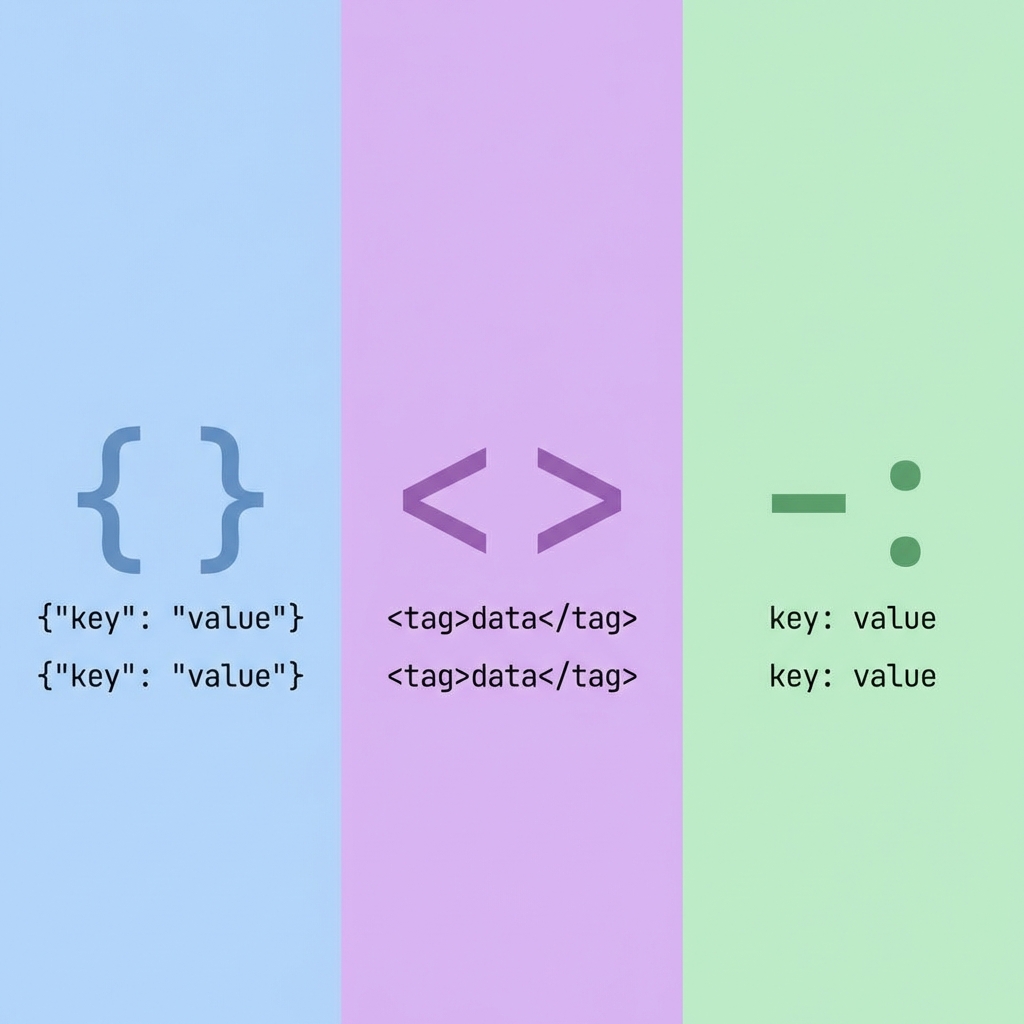
"Senior, can't we just use JSON for the config file? Why are you insisting on YAML?"
When a fresh junior developer asked me this with wide innocent eyes, I was momentarily speechless. To be honest, I thought the same way when I was a junior. "Who cares about a few extra brackets? As long as it parses, it's fine, right?"
But after you experience a system shutdown at 3 AM because a single missing comma (,) in a 5,000-line JSON file crashed the deployment, you realize something profound: Data formats are not just containers.
They are the blueprint of your system's efficiency and the primary language of your team's communication. Today, I'm going beyond the textbook definitions. I'm going to share the blood, sweat, and tears I've shed over these formats to give you the unvarnished truth about JSON, XML, and YAML.
1. JSON (JavaScript Object Notation): The King of the Web
In the early 2000s, for developers exhausted by the verbosity of XML, JSON was nothing short of a messiah.
"Simplicity is the Ultimate Weapon"
JSON's greatest strength is its intuition. Curly braces {} and square brackets [] are all you need. Since it maps 1:1 with JavaScript objects, it feels like a native language to frontend developers.
I recall replacing a heavy XML-based SOAP API with a RESTful JSON API for a mobile app project. The result? Data payload size dropped by 66%. The app became faster, and battery consumption decreased visibly. It was a miracle of efficiency.
The Fatal Flaw: "Where Are the Comments?!"
However, JSON has a critical weakness: It does not support comments.
I once used a huge JSON file for server configuration.
"timeout": 5000
Why is this 5000? What happens if I change it to 3000? There was no way to explain it in the file. We had to maintain a separate documentation wiki just to explain the config. As the saying goes, "Code without explanation is Legacy." A config file without comments is a ticking time bomb.
2. XML (eXtensible Markup Language): The Forgotten Empire
"Who uses XML in 2026? Isn't that ancient history?" If you ask this, you've clearly never worked on a banking or government project.
"The Weight of Trust"
XML requires a closing tag for every opening tag (<name>...</name>), and its syntax is strict. But this strictness is exactly why XML refuses to die.
Through schemas like XSD or DTD, you can mechanically validate data perfection before it even enters your system. In scenarios where a single misplaced decimal point could cause a financial disaster—like bank transfers or medical records—the looseness of JSON is a risk, while the rigidity of XML is a safety net.
But It Talks Too Much
The problem is verbosity and file size. Often, the tags themselves take up more space than the actual data they contain. In the mobile era where bandwidth is precious, XML was effectively exiled from the web for being too "heavy."
3. YAML (YAML Ain't Markup Language): The Human-Centric Language
These days, DevOps tools like Kubernetes, GitHub Actions, and Docker Compose almost exclusively use YAML. Why?
"Readability Supreme"
YAML has no brackets, no tags, no quotes. It uses indentation to show structure.
server:
  port: 8080
  # This is the dev server port (Comments allowed!)
Unlike JSON, you can write comments freely. This is a game-changer. The configuration file becomes its own documentation.
The Indentation Hell
However, there isn't a developer alive who hasn't sighed deeply while working with YAML. You must use spaces, never tabs. If your indentation is off by a single space, the parser explodes. It looks correct to the human eye, but the machine rejects it. That's why I tell my team: "Committing YAML without a Linter is a crime."
4. So, Which One Should You Choose? (A Senior's Guide)
Choosing a data format at the start of a project is like choosing a spouse. It's very hard to change later. Here is my criteria:
- Web/Mobile API Communication? -> Don't think, just use JSON. The entire web ecosystem is optimized for it.
- Configuration Files? -> YAML is the winner. The ability to leave comments is worth the indentation headaches. Just use a linter.
- Enterprise Data Integrity is Critical? -> Be prepared for complaints, but choose XML. 10 years from now, the maintainer will thank you for the strict validation.
There is no "best" technology, only the right tool for the job. In my recent projects, I usually adopt a "JSON for API, YAML for Config" hybrid strategy. Understanding the intent behind each technology and placing it where it belongs—that is the beginning of true software architecture.
What is the main format in your project? If you are working late because of a missing comma, maybe it's time to bravely suggest at the next meeting: "Shall we switch our config format?" Of course, the migration work... that's on you! Good luck.