
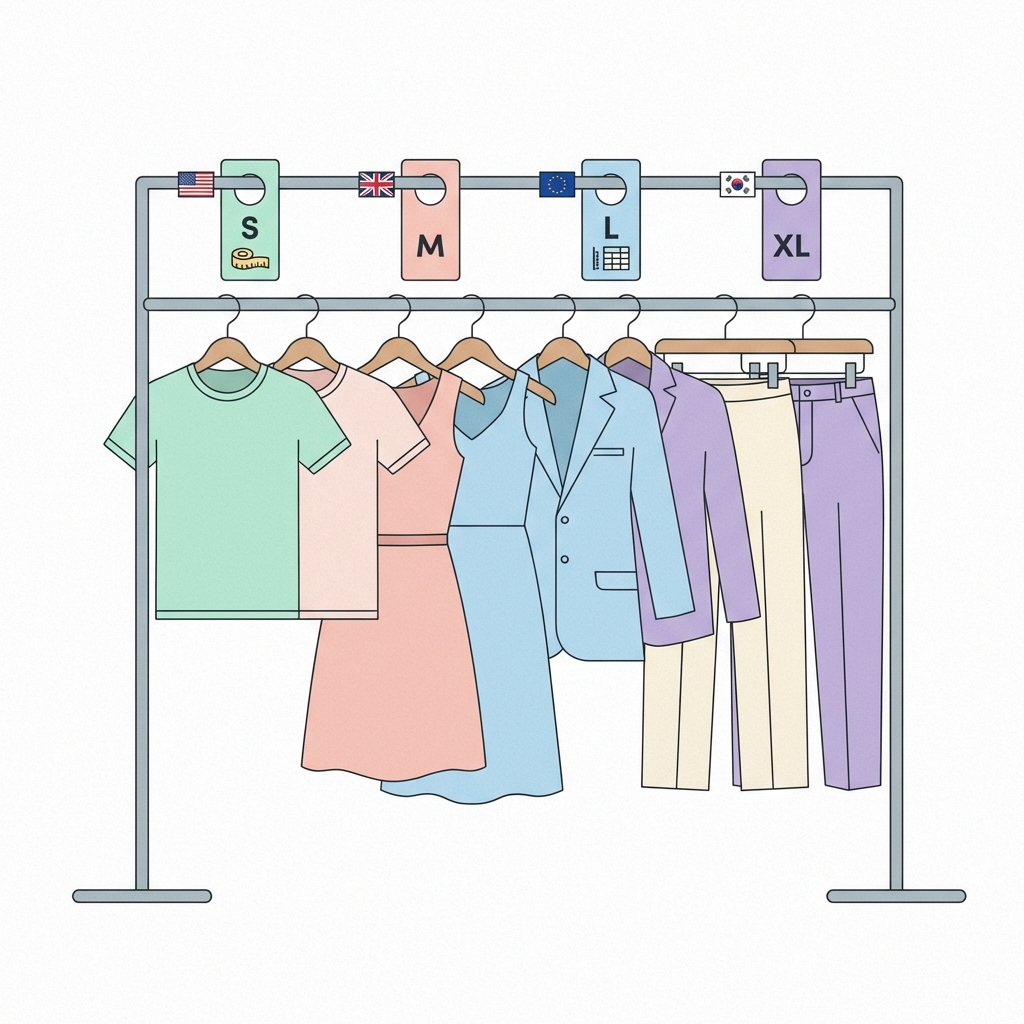
"Wait, is this really a Medium?"
I still remember the shock I felt a few years ago when I ordered my first Ralph Lauren shirt online. I confidently picked my usual "Medium," expecting a perfect fit. When it arrived, I looked like a child wearing his dad's work shirt. The sleeves covered my hands, and the torso had enough room for a second person.
That was the day I learned a hard lesson: "Not all Mediums are created equal."
This "Size Mystery" we all face isn't just about random numbers. It's a reflection of national averages, cultural preferences for how clothes should drape, and deep-seated brand identities. Today, I'm going beyond the standard conversion charts. I'm going to share the secrets of the trade and my personal playbook for navigating the global fashion market without fear. No more return shipping fees, no more disappointment.
1. Why Is Styling Across Borders So Confusing?
If you are used to shopping in Asia or parts of Europe, you might be used to a "Standard Size" that fits a relatively narrow range of body types. But step into the global market, and the rules change. A "Large" in Tokyo is a "Small" in Texas.
The main culprit is 'Standard Body Data'. In North America, the average skeletal frame is larger, and vanity sizing has shifted the baseline upwards over the decades. In contrast, Southern European countries like Italy and France have maintained a tradition of tailoring that hugs the body, meaning their sizes have remained comparatively smaller and slimmer.
Understanding these regional "vibes" is key. Let's break it down by region so you know exactly what you're getting into.
2. Women's Sizes: Decoding the Numbers Game
Women's sizing is particularly tricky because of the abstract numbering systems. 0, 2, 4, 6... what do these even mean?
The US System (Vanity Sizing Alert)
American brands are famous for "Vanity Sizing"—labeling clothes with smaller sizes to make customers feel better. This means a US Size 4 today is significantly larger than a US Size 4 from the 1990s.
- Petite / Very Slim: Look for US 0 or 2 (XS).
- Standard Slim: US 4 (S) will likely be your sweet spot.
- Average / Curvy: US 6 or 8 (M) offers more room.
The European Reality Check
European sizing (derived from chest/bust measurements in centimeters) is generally more consistent but usually runs smaller than its American equivalent. A standard rule of thumb for converting US to EU is to add 30 (or 32 depending on the brand).
- US 4 ≈ EU 36
- US 6 ≈ EU 38
Critical Warning: Do not confuse EU sizes with Italian (IT) sizes! Italian fashion is in a league of its own. An Italian 38 is tiny—roughly an EU 34. Rule: Italian Size = EU Size + 4. (e.g., If you wear an EU 36, you need an IT 40). Getting this wrong is the #1 reason for returns on luxury sites like Farfetch or Yoox.
💡 Pro Tip for dresses
When buying American dresses, pay closest attention to the 'Bust' measurement. Western tailoring often allows for more hip room (pear shapes are common), but the bust fit is often the make-or-break factor for the garment's silhouette.
3. Men's Sizes: The Battle of "Classic" vs. "Slim"
Gentlemen, if you think you are an "XL" globally because you are an "XL" at home, you are in for a surprise.
Tops: The "One Size Down" Rule
For classic American heritage brands (think heavy cotton t-shirts, flannels, parkas), the cut is generous. It's built for comfort and often assumes a taller, broader frame.
- The Strategy: Unless you specifically want an oversized streetwear look, size down one step from your Asian or European size.
- Global L -> US M
- Global XL -> US L
However, if the item is marked 'Slim Fit', stick to your normal size. "Slim Fit" in the US brings the dimensions closer to the global standard.
Bottoms: It's All About the "Inseam"
Men's pants are usually sold by Waist (W) x Inseam (L). The mistake most men make is ignoring the length.
- 30L: Standard for men around 173-178cm (5'8" - 5'10").
- 32L: For the taller crowd, 180cm+ (5'11"+).
- 34L: Truly tall territory, 188cm+ (6'2"+).
Don't buy a 34L thinking "I'll just hem it." Complex washes on denim or tapered ankles on chinos will be ruined if you chop off 4 inches. Buy the right length from the start.
4. The Secret Weapon: "Garment Measurements"
Conversion charts are useful estimates, but Garment Measurements are facts. Every time I shop, I do this:
- Grab my absolute favorite-fitting jacket or pants.
- Lay them flat on a table.
- Measure the Pit-to-Pit (armpit to armpit) and the Total Length.
When I look at an online store, I ignore the "Body Measurements" (which tell you what body size they think fits the cloth) and look for "Product Dimensions" or "Garment Width." If I know my favorite tee is 55cm across the chest, and the size chart says the 'Medium' is 56cm, I click buy instantly. No guessing required.
5. Brand-Specific Vibes (My Personal Cheat Sheet)
After years of trial and error (and many return labels), here is my mental map:
- Polo Ralph Lauren: Huge. The 'Classic Fit' is a tent. 'Custom Slim' is the way to go for a modern look.
- COS / Arket: Boxy and architectural. Tops run large (oversized aesthetic), but pants are often true to size.
- Nike / Adidas: Global standard. Usually consistent, but 'Basketball' lines run huge while 'Running' lines run tight.
- AMI / Maison Kitsuné: French sizing. Small shoulders, shorter lengths. Size up if you have broad shoulders or a long torso.
- Lululemon: Technical gear meant to compress. Men should often size up for comfort; women should stick to the size chart but watch for length (Asia Fit vs. Global Fit).
Shopping globally is one of the great joys of the internet age. You have access to brands and styles that simply don't exist in your local mall. But the bridge between "Adding to Cart" and "Looking Good" is knowledge.
Don't let a fear of numbers stop you. Measure your best clothes, understand the "nationality" of the brand you're buying, and trust the centimeter over the size tag. Once you crack this code, the whole world becomes your wardrobe. Happy hunting!